Research Article | | Peer-Reviewed

Design Guide for Modelling Damping in Reinforced Concrete Coupling Beams Under Cyclic Loading

Received: 18 March 2026     Accepted: 30 March 2026     Published: 14 April 2026
Views:       Downloads:
Abstract

Damping is a measure of energy dissipation, and while coupling beams contribute to this through yielding and nonlinear behaviour, conventional structural design software does not assign a specific damping ratio to these members. Reinforced Concrete coupling beams protect the shear walls or cores by absorbing and dissipating seismic energy through cracking and rotation, making their damping estimation crucial in lateral design. This technical note introduces two complementary power-law models for estimating damping in Reinforced Concrete coupling beams subjected to the deemed effects of cyclic loading. The first model relates damping (D) to stress amplitude (σₐ), and the second model expresses D as a function of plastic hinge rotation (θ). Both models are rooted in Khanna’s earlier ICE (Institution of Civil Engineers-1976) work and are demonstrated using a 20-storey structural example. To enhance practical relevance, the methodology employs an equivalent static approach, avoiding full time-history or Finite Element Method (FEM) -based hysteretic modelling. The note also introduces the role of soil–structure interaction (SSI) and compares damping predictions from both models across elastic, cracked, and yielded states. Normalized design curves and manual worked examples illustrate that the stress amplitude model is more responsive to early-stage material cracking, while the rotation-based model reflects overall deformation. This combined framework offers structural designers a transparent, physics-based guide to assessing damping in coupling beams and is useful for performance-based seismic design, retrofit evaluation, and simulation benchmarking. This technical note presents two complementary power-law models for quantifying damping behavior in reinforced concrete (RC) coupling beams under cyclic loading. The first model relates damping (D) to stress amplitude (σₐ), while the second relates damping (D) to plastic hinge rotation (θ). Together, they offer a practical framework for estimating hysteretic damping without full-scale Finite Elelement Method (FEM) analysis. The note also introduces the role of soil–structure interaction (SSI) and compares damping predictions from both models across elastic, cracked, and yielded states. Normalized design curves and manual worked examples illustrate that the stress amplitude model is more responsive to early-stage material cracking, while the rotation-based model reflects overall deformation. This combined framework offers structural designers a transparent, physics-based guide to assessing damping in coupling beams and is useful for performance-based seismic design, retrofit evaluation, and simulation benchmarking.

Published in American Journal of Civil Engineering (Volume 14, Issue 2)
DOI 10.11648/j.ajce.20261402.16
Page(s) 104-111
Creative Commons

This is an Open Access article, distributed under the terms of the Creative Commons Attribution 4.0 International License (http://creativecommons.org/licenses/by/4.0/), which permits unrestricted use, distribution and reproduction in any medium or format, provided the original work is properly cited.

Copyright

Copyright © The Author(s), 2026. Published by Science Publishing Group

Keywords

Structures & Buildings Design, Concrete Structures, Damping

1. Introduction
Reinforced concrete coupling beams in shear wall systems play a critical role in dissipating lateral energy during seismic events and enhancing overall structural ductility in coupled wall systems in dissipating lateral energy during seismic events. is crucial for designing earthquake-resistant structures and has been widely studied through experimental and analytical investigations on RC coupling beams under cyclic loading .
It is crucial for designing earthquake-resistant structures. Khanna (1976) proposed a power-law form D = J σₐⁿ to express how damping varies with cyclic stress amplitude, highlighting the need to incorporate both material behavior and interaction effects. This model helps in estimating damping without extensive testing. Additional damping model based on plastic hinge rotation is compared.
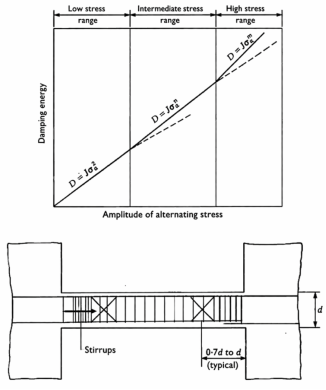
A sketch showing the three stage damping basic curve for stress amplitude case and another sketch showing coupling beam with plastic hinge at each end, is as Figure 1 to introduce the graphics of the models used.
Despite extensive research, simplified design-oriented damping models for coupling beams remain limited, motivating the present study.
Upper sketch for D v/s σₐ & lower sketch for D v/s θ

Download: Download full-size image

Figure 1. Represents the two models.
2. Stress Amplitude Mode
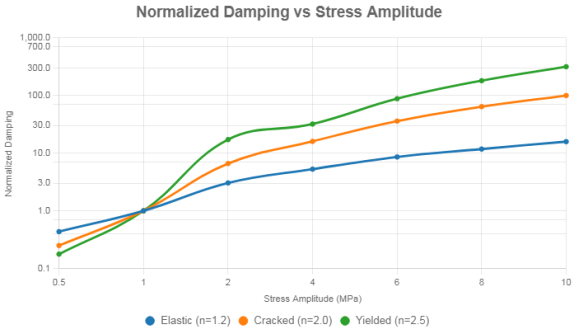
This model has been deployed to develop design curves in Figure 2. Manually, D-values for a few computed stress amplitude values have been calculated using n-values of Table 1 and listed in Table 2. Curves in Figure 2 have been developed for D v/s σₐ to cover a wide range of values.
2.1. Theoretical Model
The model is given by:
D = J * σₐ^n
Where:
1) D: Normalized damping (energy dissipated per cycle)
2) J: Damping constant (assumed 1 for general curve)
3) σₐ: Stress amplitude (MPa)
4) n: Damping exponent, variable based on material state
Table 1. Suggested values of ‘n’.

Zone

Description

Exponent (n)

Elastic Zone

1.2

Cracked Zone

Cracking & bond slip initiation

2.0

Yielded Zone

Plastic hinge formation and yielding

2.5

2.2. Manual Estimation of Stress Amplitude
In the present study, the dynamic and cyclic nature of seismic action is not modelled explicitly through time-history or hysteretic analysis. Instead, an equivalent static lateral-loading procedure is used to generate beam shear, stress amplitude and chord rotation demands. These response quantities are taken as practical engineering indicators of the deemed effects of cyclic loading, thereby allowing simplified correlation of static design actions with expected damping and energy dissipation behaviour of Reinforced Concrete coupling beams.
This approach provides a transparent and interpretable method for estimating damping in seismic design, especially when full dynamic models are unavailable or not justified in early-stage design.
Step 1: Estimate Seismic Shear at Each Floor
Use the equivalent static method as adopted in seismic design provisions such as IS 1893 (2016) and international codes ASCE 7-16 .
Vᵢ = wᵢ * hᵢ / Σ w * h * V_base
where V_base = A * W and A is the horizontal seismic coefficient from relevant seismic codes.
Step 2: Determine Coupling Beam Shear Force
Assume 20–30% of total overturning moment is resisted by coupling action:
V_b = M_couple / L
where L is the span length of the coupling beam.
Step 3: Calculate Maximum Shear Stress
Assuming a rectangular beam section:
τ_max = 1.5 * V_b / (b * d)
where b and d are the beam width and overall depth, respectively.
Step 4: Estimate Stress Amplitude
Set σₐ = τ_max and substitute into the damping model for arriving at values of ‘D’:
D = J * σₐⁿ
While full-scale finite element analysis can provide accurate cyclic stress amplitudes in RC coupling beams, a simplified manual method is essential for conceptual design and quick evaluations. This section outlines a practical procedure to estimate stress amplitude (σₐ) without using FEM or specialized software.
In the present study, the effect of soil-structure is considered as a modifying factor in the estimation of stress amplitude in reinforced concrete coupling beams under equivalent static seismic loading.
Early analytical formulations for dynamic soil–structure interaction were presented by Wolf , who proposed simplified physical models for evaluating foundation–soil coupling effects in vibrating structural systems In practical design, RC coupling beams in shear wall systems interact with foundations and subsoil, particularly in soft soil zones or sites with embedded basements. Soil-structure interaction (SSI) alters the lateral force distribution and base shear estimate used in stress amplitude calculation. To incorporate SSI effects, base shear (V_base) may be reduced due to flexibility at foundation level and corresponding wall moments may redistribute, reducing or increasing the portion transferred to coupling beams. Parametric studies incorporating a spring-supported base or impedance function can refine stress amplitude estimates. In this context the presented model can be updated by modifying input shear stress accordingly. Further extension is recommended for full SSI coupling in performance based design as established in classical and modern SSI studies .
2.3. Worked Example – 20-Storey Building
The following example illustrates the manual estimation of stress amplitude for a 20-storey shear wall building with RC coupling beams.
1) Number of stories: 20
2) Typical floor height (h): 3.2 m
3) Seismic zone factor (Z): 0.16 (e.g., Zone III)
4) Importance factor (I): 1.0
5) Response reduction factor (R): 5
6) Total weight (W): 120,000 kN
7) Wall spacing (beam span, L): 3.5 m
8) Coupling beam size: 300 mm × 900 mm
Step 1: Seismic Base Shear
A = (Z * I) / (2* R) = (0.16 * 1.0) / (2* 5) = 0.016
V_base = A * W = 0.016 * 120,000 = 1920 kN
Wall shear share via coupling: 25%
Step 2: Moment and Shear in Coupling Beam
M_OT = V_base * H = 1920 * (20* 3.2) = 122,880 kNm
M_couple = 0.25 * M_OT = 30,720 kNm
M_per_beam = 30,720 / 19 ≈ 1617 kNm
V_b = M_per_beam / L = 1617 / 3.5 ≈ 462 kN
Step 3: Max Shear Stress
A = 0.3 * 0.9 = 0.27 m²
τ_max = (1.5 * 462 * 10³) / 0.27 ≈ 2.57 MPa
Step 4: Damping Estimate
Assume n = 2.0 (cracked zone), D = (2.57)^2 ≈ 6.60
This confirms the practical use of the damping model using hand-estimated stress amplitudes without full FEM.
2.4. Tabulated Design Values
Representative damping values computed using the power-law model are listed below:
Table 2. Stress Amplitude Case.

Stress Amplitude (MPa)

D (Elastic, n=1.2)

D (Cracked, n=2.0)

D (Yeilded, n=2.5)

0.5

0.435

0.25

0.177

1.0

1.000

1.00

1.000

2.0

3.044

6.60

17.175

4.0

5.278

16.00

32.000

6.0

8.586

36.00

88.100

8.0

11.783

64.00

181.020

10.0

15.849

100.00

316.200

2.5. Design Curves
The curves are based on pure power-law expressions and may overestimate damping growth at high stress amplitudes. In practice post-yield damping often stabilizes due to material situation.
Figure 2. Idealised Curves for model D v/s σₐ.
The stress amplitude model uses data from Table 2, with σ_a ranging from 0.5 to 10 MPa and D computed as σ_a^n (n=1.2, 2.0, 2.5 for elastic, cracked, and yielded zones). Curves are plotted using linear and logarithmic y-axes to compare shapes.
3. Plastic Hinge Rotation Model
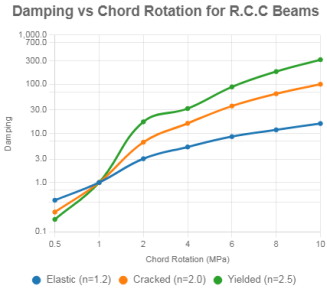
For this model, design curves have been developed as in Figure 3. Using theoretical equations under paragraph 3.1 and for values of ‘m’ as per Table 3, chord rotation for a storey drift value is calculated for which D-value is computed. Table 4 shows values computed for a few storey drift values. Curves, D v/s θ in Figure 3 have been drawn to cover a range of values. The use of plastic hinge rotation as a measure of inelastic deformation is consistent with performance-based seismic design approaches per ASCE 41-17 & FEMA 356 .
3.1. Theoretical Model
This complementary model expresses damping as a power-law function of plastic hinge rotation or chord rotation:
[D = K ^m]
Where:
1) (D): Normalized energy dissipation per cycle
2) (theta): Chord rotation (radians)
3) (K): Damping coefficient (normalized)
4) (m): Exponent indicating nonlinear growth (typically 1.2–2.5)
Table 3. Suggested values for (m).

Zone

Description

Exponent (m)

Elastic Zone

Microcracking rotation only

1.2

Cracked Zone

Flexural Cracking and bar slippage

2.0

Yielded Zone

Full plastic rotation at hinges

2.5

3.2. Worked Example – Plastic Hinge-Based Damping
In line with building parameters under para 2.2, the plastic hinge-based method is now worked with the same geometry.
1) Storey height = 3.2 m → Total height = 64 m
2) Coupling beam clear span L = 3.5 m (same as para 8)
3) Plastic hinge length ≈ 0.4 m
4) Peak lateral displacement at roof (Δ_roof) = 300 mm
Rotation at beam end: θ ≈ Δ / H = 300 mm / 64000 mm = 0.00469 radians
Using the yielded zone curve D = θⁿ with n = 2.5, we get:
D = (0.00469)^2.5 ≈ 2.3 × 10⁻⁵
This is significantly lower than the stress-amplitude-based estimate (D ≈ 6.60), showing the plastic hinge model underestimates damping for small displacements.
3.3. Tabulated Design Values
Representative damping values computed using the power-law model are listed below:
Table 4. Plastic Hinge Rotation case.

Chord rotation (θ in radian)

D (Elastic, m=1.2)

D (Cracked, m=2.0)

D (Yielded, m=2.5)

0.002

0.007

0.000004

0.00000018

0.004

0.014

0.000016

0.0000013

0.008

0.028

0.000064

0.0000095

0.012

0.041

0.00014

0.00003

0.020

0.064

0.00040

0.00018

0.030

0.089

0.00090

0.00051

0.040

0.113

0.00160

0.0014

3.4. Design Curves
The curves are based on pure power-law expressions and may overestimate damping growth at high stress amplitudes. In practice post-yield damping often stabilizes due to material situation.
The plastic hinge model relies on Table under paragraph 4, with θ from 0.002 to 0.040 rad and D values approximating θ^m (m=1.2, 2.0, 2.5). Curves are plotted using linear and logarithmic y-axes to compare shapes.
Figure 3. Idealized Curves for D v/s θ.
4. Applications and Implications
1) Useful in preliminary seismic design and assessment of RC coupling beams.
2) Can be embedded in finite element modeling as a nonlinear material damping model.
3) Helps estimate performance levels and expected damage severity.
4) Assists in lifecycle-based structural resilience and repair planning.
5) Whereas the stress-based model supports material-level damping input; the hinge model.
6) reflects rotational ductility.
5. Comparison of Damping Estimation and Their Role
To reinforce the practicality of the stress-based damping model, a comparative evaluation with the conventional rotation-based plastic hinge method is included.
Table 5. Summarizes typical damping values estimated using both models under varying levels of lateral displacement.

Storey Drift (mm)

Rotation (θ, radian)

Damping (Plastic hinge method)

Damping (Stress based power law)

12

0.004

0.012

0.010

18

0.006

0.025

0.020

24

0.008

0.041

0.035

30

0.10

0.060

0.050

Two approaches to estimating damping in RC coupling beams under cyclic loading have been illustrated. Typically,
Stress-Amplitude Method**: Based on calculated shear stress amplitude (≈ 2.57 MPa), yielding D ≈ 6.60 in cracked zone, and
Plastic Hinge Rotation Method**: Based on top displacement (300 mm), yielding θ ≈ 0.00469 rad, resulting in D ≈ 2.3 × 10⁻⁵.
Clearly, the stress-based model produces more conservative damping estimates and is more responsive to material cracking and bond-slip behavior, while the hinge based model is sensitive to global deformation, define damping near ultimate rotation but may underestimate energy dissipation at lower rotation levels consistent with observed differences between local material-level energy dissipation and global deformation-based damping models .
Designers may use the stress-based model for conservative seismic design and plastic hinge model for performance-based analyses with measured or target displacements.
This dual approach enriches engineering judgment.
Moreover, both the stress amplitude (shear force) and the chord rotation demand at the plastic hinges of shear wall coupling beams generally differ significantly with height in a building structure, particularly during a seismic event. This vertical variation influences the distribution of energy dissipation and must be considered when assigning floor-wise damping ratios. Damping across storey heights per evaluation in next para, have been tabulated in Table 6.
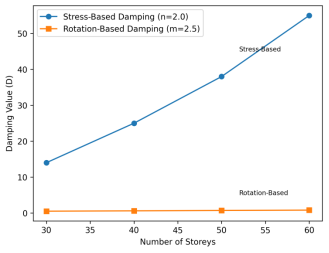
To further explore the applicability of the two damping models, a comparative evaluation was carried out for 30, 40, 50, and 60-storey buildings using the same equivalent static methodology. The stress amplitude was estimated from increased overturning moments with height, while the chord rotation was derived from a constant assumed roof drift of 300 mm. The results are presented in the table below.
Table 6. Damping for storeys 30 to 60.

Storeys

Height (m)

σₐ (MPa)

D (Stress-Based)

θ (rad)

D (Rotation-Based)

30

96.0

3.78

14.31

0.00313

5.46 × 10⁻⁷

40

128.0

5.00

25.01

0.00234

2.66 × 10⁻⁷

50

160.0

6.22

38.68

0.00187

1.52 × 10⁻⁷

60

192.0

7.44

55.33

0.00156

9.65 × 10⁻⁸

It is observed that damping values estimated via the stress amplitude method increase with building height, due to higher base shear and larger coupling moments, making this model conservative and sensitive to early-stage material cracking. In contrast, the rotation-based model exhibits significantly lower damping values, as roof displacement is held constant and rotation θ decreases with increasing height. These trends reinforce the recommendation that stress-based damping is suitable for conservative seismic design, while rotation-based damping may be applied in performance-based evaluations with measured or target drift levels.
Figure 4. Variation of Damping with Building Height (30–60 Storeys).
6. How This Guide Helps
While modern structural software provides comprehensive analysis and design capabilities, it often operates as a black box, obscuring the underlying mechanics and response behavior. This design guide offers a transparent, physics-based model that helps structural engineers intuitively understand the damping response of RC coupling beams.
It is particularly valuable during the conceptual design stage, for rapid parametric assessments, code validation, or as a benchmark for verifying complex nonlinear simulations. In seismic design and retrofit scenarios—where computational efficiency, interpretability, and engineering judgment are critical—such simplified models enhance decision-making, resilience evaluation, and design confidence.
7. Innovation and Contribution
This technical note introduces a simplified dual-model framework to estimate damping in RC coupling beams using equivalent static inputs rather than full cyclic or time-history analysis. The novelty lies in:
Two complementary models (stress amplitude-based and plastic rotation-based), each tied to realistic design quantities.
Normalized design curves for quick manual estimation of damping without specialized FEM tools.
Comparison between local stress-based damping and global drift-based damping, highlighting their differing conservatisms.
Inclusion of SSI effects as a modular enhancement, extending the model to real-world soil conditions.
Existing literature addresses cyclic response qualitatively or through complex modeling, whereas this article presents an engineer-friendly design guide for practical use in seismic design and retrofitting.
While the proposed models provide practical estimates, calibration against experimental data or detailed non-linear time- history analysis is recommended for critical structures. Future work may focus on validating the models using laboratory and field observations.
8. Conclusion
The proposed damping model, based on the 1976 ICE discussion, provides a valuable framework for assessing energy dissipation in RCC coupling beams. It serves as a practical engineering tool for seismic design, particularly when experimental data is limited or unavailable.
Abbreviations

ICE

Institution of Civil Engineers

FEM

Finite Element Method

SSI

Soil Structure Interaction

RC

Reinforced Concrete

EIL

Engineers India Limited

ASCE

American Society of Civil Engineers

GOI

Govt of India

Acknowledgments
The author gratefully acknowledges his prior professional experiences as a Design Engineer in Central Public Works Department, GOI, working on three 20 storeyed RCC buildings, which originally exposed him to these challenging tall buiding design issues with exposure to FEM while working with EIL. The author also wishes to recognize the various contributions of previous academic research in the fields of finite element modelling, coupling beams in high rises, and soil-structure interaction which form the technical basis for this study.
Author Contributions
Vijay KumarKhanna: Conceptualisation, DataCuration, Formal Analysis, Funding acquisition, Investigation, Methodology, Project administration, Resources, Supervision, Validation, Visualization, Writing – original draft
Conflicts of Interest
The author declares there is no conflict of interest.
References
[1] Paulay, T. & Priestley, M. J. N. (1992). Seismic Design of Reinforced Concrete and Masonry Buildings. Wiley.
[2] Paulay, T. & Binney, J. R. (1974). Diagonal reinforcement in coupling beams. ACI Journal, 71(3), pp. 108-115.
[3] Popov, E. P. & Bertero, V. V. (1975). Cyclic loading of RC members. Earthquake Engineering & Structural Dynamics, 3(1), pp. 37-52.
[4] Khanna, V. K. (1976). Discussion on Irwin & Ord. ICE Proceedings, Part 2, 61, pp. 845-847.
[5] ASCE 7-16. Minimum Design Loads for Buildings and Other Structures. ASCE.
[6] Wolf, J. P. (1985). Dynamic Soil-Structure Interaction. Prentice Hall, pp 15-18 (basic SSI).
[7] Gazetas, G. (1991). Formulas and charts for impedances of foundations. Journal of Geotechnical Engineering, 117(9), pp. 1363-1381.
[8] ASCE 41-17. Seismic Evaluation and Retrofit of Existing Buildings. ASCE.
[9] FEMA 356 (2000). Prestandard for Seismic Rehabilitation of Buildings.
[10] Chopra, A. K. (2012). Dynamics of Structures (4th Ed.). Prentice Hall, pp 340-370.
Cite This Article
  • APA Style

    Khanna, V. K. (2026). Design Guide for Modelling Damping in Reinforced Concrete Coupling Beams Under Cyclic Loading. American Journal of Civil Engineering, 14(2), 104-111. https://doi.org/10.11648/j.ajce.20261402.16

    Copy | Download

    ACS Style

    Khanna, V. K. Design Guide for Modelling Damping in Reinforced Concrete Coupling Beams Under Cyclic Loading. Am. J. Civ. Eng. 2026, 14(2), 104-111. doi: 10.11648/j.ajce.20261402.16

    Copy | Download

    AMA Style

    Khanna VK. Design Guide for Modelling Damping in Reinforced Concrete Coupling Beams Under Cyclic Loading. Am J Civ Eng. 2026;14(2):104-111. doi: 10.11648/j.ajce.20261402.16

    Copy | Download

  • @article{10.11648/j.ajce.20261402.16,
      author = {Vijay Kumar Khanna},
      title = {Design Guide for Modelling Damping in Reinforced Concrete Coupling Beams Under Cyclic Loading},
      journal = {American Journal of Civil Engineering},
      volume = {14},
      number = {2},
      pages = {104-111},
      doi = {10.11648/j.ajce.20261402.16},
      url = {https://doi.org/10.11648/j.ajce.20261402.16},
      eprint = {https://article.sciencepublishinggroup.com/pdf/10.11648.j.ajce.20261402.16},
      abstract = {Damping is a measure of energy dissipation, and while coupling beams contribute to this through yielding and nonlinear behaviour, conventional structural design software does not assign a specific damping ratio to these members. Reinforced Concrete coupling beams protect the shear walls or cores by absorbing and dissipating seismic energy through cracking and rotation, making their damping estimation crucial in lateral design. This technical note introduces two complementary power-law models for estimating damping in Reinforced Concrete coupling beams subjected to the deemed effects of cyclic loading. The first model relates damping (D) to stress amplitude (σₐ), and the second model expresses D as a function of plastic hinge rotation (θ). Both models are rooted in Khanna’s earlier ICE (Institution of Civil Engineers-1976) work and are demonstrated using a 20-storey structural example. To enhance practical relevance, the methodology employs an equivalent static approach, avoiding full time-history or Finite Element Method (FEM) -based hysteretic modelling. The note also introduces the role of soil–structure interaction (SSI) and compares damping predictions from both models across elastic, cracked, and yielded states. Normalized design curves and manual worked examples illustrate that the stress amplitude model is more responsive to early-stage material cracking, while the rotation-based model reflects overall deformation. This combined framework offers structural designers a transparent, physics-based guide to assessing damping in coupling beams and is useful for performance-based seismic design, retrofit evaluation, and simulation benchmarking. This technical note presents two complementary power-law models for quantifying damping behavior in reinforced concrete (RC) coupling beams under cyclic loading. The first model relates damping (D) to stress amplitude (σₐ), while the second relates damping (D) to plastic hinge rotation (θ). Together, they offer a practical framework for estimating hysteretic damping without full-scale Finite Elelement Method (FEM) analysis. The note also introduces the role of soil–structure interaction (SSI) and compares damping predictions from both models across elastic, cracked, and yielded states. Normalized design curves and manual worked examples illustrate that the stress amplitude model is more responsive to early-stage material cracking, while the rotation-based model reflects overall deformation. This combined framework offers structural designers a transparent, physics-based guide to assessing damping in coupling beams and is useful for performance-based seismic design, retrofit evaluation, and simulation benchmarking.},
     year = {2026}
    }
    

    Copy | Download

  • TY  - JOUR
    T1  - Design Guide for Modelling Damping in Reinforced Concrete Coupling Beams Under Cyclic Loading
    AU  - Vijay Kumar Khanna
    Y1  - 2026/04/14
    PY  - 2026
    N1  - https://doi.org/10.11648/j.ajce.20261402.16
    DO  - 10.11648/j.ajce.20261402.16
    T2  - American Journal of Civil Engineering
    JF  - American Journal of Civil Engineering
    JO  - American Journal of Civil Engineering
    SP  - 104
    EP  - 111
    PB  - Science Publishing Group
    SN  - 2330-8737
    UR  - https://doi.org/10.11648/j.ajce.20261402.16
    AB  - Damping is a measure of energy dissipation, and while coupling beams contribute to this through yielding and nonlinear behaviour, conventional structural design software does not assign a specific damping ratio to these members. Reinforced Concrete coupling beams protect the shear walls or cores by absorbing and dissipating seismic energy through cracking and rotation, making their damping estimation crucial in lateral design. This technical note introduces two complementary power-law models for estimating damping in Reinforced Concrete coupling beams subjected to the deemed effects of cyclic loading. The first model relates damping (D) to stress amplitude (σₐ), and the second model expresses D as a function of plastic hinge rotation (θ). Both models are rooted in Khanna’s earlier ICE (Institution of Civil Engineers-1976) work and are demonstrated using a 20-storey structural example. To enhance practical relevance, the methodology employs an equivalent static approach, avoiding full time-history or Finite Element Method (FEM) -based hysteretic modelling. The note also introduces the role of soil–structure interaction (SSI) and compares damping predictions from both models across elastic, cracked, and yielded states. Normalized design curves and manual worked examples illustrate that the stress amplitude model is more responsive to early-stage material cracking, while the rotation-based model reflects overall deformation. This combined framework offers structural designers a transparent, physics-based guide to assessing damping in coupling beams and is useful for performance-based seismic design, retrofit evaluation, and simulation benchmarking. This technical note presents two complementary power-law models for quantifying damping behavior in reinforced concrete (RC) coupling beams under cyclic loading. The first model relates damping (D) to stress amplitude (σₐ), while the second relates damping (D) to plastic hinge rotation (θ). Together, they offer a practical framework for estimating hysteretic damping without full-scale Finite Elelement Method (FEM) analysis. The note also introduces the role of soil–structure interaction (SSI) and compares damping predictions from both models across elastic, cracked, and yielded states. Normalized design curves and manual worked examples illustrate that the stress amplitude model is more responsive to early-stage material cracking, while the rotation-based model reflects overall deformation. This combined framework offers structural designers a transparent, physics-based guide to assessing damping in coupling beams and is useful for performance-based seismic design, retrofit evaluation, and simulation benchmarking.
    VL  - 14
    IS  - 2
    ER  - 

    Copy | Download

Author Information
  • Civil Engineering Department, Birla Institute Technology & Science, Pilani, India;Engineers India Limited, New Delhi, India

    Biography: Vijay Kumar Khanna has diverse professional experience, 19 years in civil/structural engineering (design & review) and project management, 20 years in oil and gas sector project execution, and 17 years in marketing of process instruments and non-destructive evaluation tools for civil/structural applications. Currently engaged in engineering consultancy and technical writing. He has authored fourteen publications in the form of Discussions (ICE journals), Articles (HP, H2-TECH, PGJ), Conference Papers to GEOTECH-80, IBMAC (Australia-1984), Research Papers to AJCE. He earned B. Engineering & DBM.